
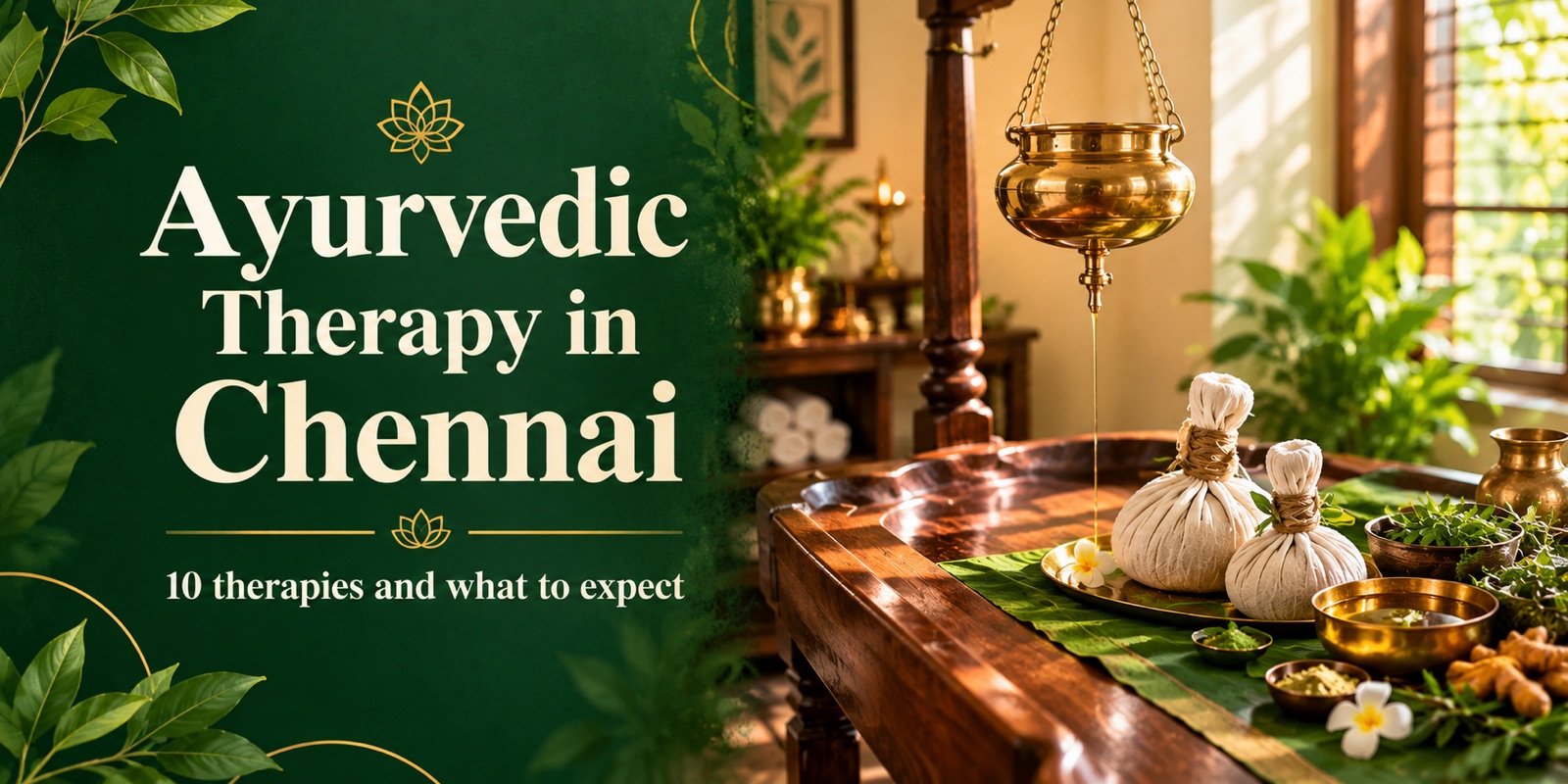
If you are looking for Ayurvedic therapy in Chennai, the number of names can be confusing: Abhyanga, Shirodhara, Kizhi, Basti, Nasyam and many more. Each one works differently and suits different health problems, so the right choice depends on you, not on a package list.
This guide explains ten common Ayurvedic therapies, what each is used for, what happens at your first visit, how many sessions you may need, and who should speak to a doctor before starting.
What Is Ayurvedic Therapy?
Ayurvedic therapy is a treatment given with herbal oils, powders, decoctions or steam, chosen by an Ayurvedic doctor to bring the three doshas (Vata, Pitta and Kapha) back into balance. It is usually combined with herbal medicines and advice on diet and daily routine.
A good Ayurvedic therapy is not a fixed spa menu. The doctor first examines you, then decides which therapy, which oil and how many sessions you need.
10 Common Ayurvedic Therapies
1. Abhyanga (full-body oil massage)
A full-body massage with warm medicated oil, given in set strokes. It is used for stiffness, tiredness, poor sleep and dry skin, and as a preparation before Panchakarma. Read more about Abhyangam treatment in Chennai.
2. Shirodhara (oil poured on the forehead)
A slow, steady stream of warm oil or medicated liquid is poured on the forehead for a set time. It is mainly used for stress, anxiety, poor sleep and headaches, and in some hair-loss and skin plans. See Shirodhara treatment cost in Chennai.
3. Panchakarma (five-step cleansing)
A planned course of cleansing therapies (Vamana, Virechana, Basti, Nasya and Raktamokshana) given in stages over several days. It is used for long-standing joint, skin, digestive and lifestyle problems. Read our guide to Panchakarma treatment in Chennai.
4. Basti (medicated enema)
Herbal oils or decoctions are given through the rectum. Ayurveda regards Basti as the main therapy for Vata disorders such as back pain, joint pain and constipation.
5. Nasyam (nasal therapy)
Medicated oil or drops are given through the nose after a gentle face massage and steam. It is used for sinus problems, headaches, neck stiffness and some hair-fall plans.
6. Kizhi (herbal poultice massage)
Cloth bundles filled with warm herbs, leaves or powders are dipped in oil and pressed over the body. Kizhi is mainly used for joint pain, muscle stiffness and swelling.
7. Pizhichil (warm oil bath)
Warm medicated oil is poured over the body in a steady stream while two therapists massage at the same time. It is used for nerve weakness, joint stiffness and general rejuvenation.
8. Kati Vasti and Janu Vasti (local oil pooling)
A ring of dough is placed on the lower back (Kati Vasti) or the knee (Janu Vasti) and filled with warm medicated oil for a set time. These are used for back pain, slipped disc and knee arthritis. Read about Janu Vasti for knee pain.
9. Swedana (herbal steam)
Herbal steam is given to the whole body or one area after an oil massage. It loosens stiffness and is usually part of a longer therapy plan.
10. Lepanam (herbal paste)
A paste of herbs is applied to the skin or a painful joint and left to dry. It is used in some skin conditions such as psoriasis and eczema, and for local swelling.
Which Problems Is Ayurvedic Therapy Used For?
Ayurvedic doctors commonly use these therapies as part of treatment for:
- Back pain, neck pain, slipped disc and sciatica
- Knee pain, arthritis and frozen shoulder
- Skin problems such as psoriasis and eczema
- Stress, anxiety and poor sleep
- Digestive problems such as bloating and constipation
- Women’s health concerns such as irregular periods
- Hair fall and sinus problems
Therapy is usually one part of the plan, alongside herbal medicines, diet and daily routine.
What Happens at Your First Visit
- Consultation: the doctor asks about your symptoms, past illnesses, medicines, diet, sleep and daily routine, and checks your pulse (Nadi Pariksha) and body type.
- Treatment plan: you are told which therapies you need, in what order, and for how many days.
- Therapy session: sessions are given by trained therapists in a private room. Their length depends on the therapy: Janu Vasti takes about 20 to 30 minutes and Shirodhara about 30 to 45 minutes.
- Follow-up: the doctor reviews how you are responding and adjusts the plan.
How Many Sessions Will You Need?
It depends on the problem. A single Abhyanga or Shirodhara session can help you relax, but long-standing pain or skin problems usually need a course of sessions over several days. A short Panchakarma course runs for at least 7 days, and a fuller course can last 21 to 28 days. Your doctor will tell you the expected length at the first visit.
Ayurvedic Therapy vs a Spa Ayurvedic Massage
Many people searching for an Ayurvedic massage in Chennai find spa menus. The difference matters:
- Doctor-led: at a hospital, a qualified Ayurvedic doctor decides the therapy after examining you. A spa usually offers a fixed menu.
- Medicated oils: the oil is chosen for your condition and body type, not for its fragrance.
- Part of a plan: therapy is combined with medicines, diet and follow-up, so the results can last.
Who Should Speak to a Doctor First
Tell the Ayurvedic doctor before any therapy if you:
- Are pregnant or breastfeeding
- Have a fever, an infection or an open wound
- Have heart disease, very high or low blood pressure, or diabetes that is not controlled
- Have recently had surgery
- Take regular medicines (do not stop them on your own)
Ayurvedic Therapy at Shree Kriyas Ayurveda Hospitals, OMR
At Shree Kriyas Ayurveda Hospitals in Okkiyam Thoraipakkam, on OMR, every course of Ayurvedic therapy starts with a consultation of at least 30 minutes. Most of our medicines and oils are made in-house, and our team follows up with you through the treatment and after it ends.
We are open from 8:30 AM to 8:30 PM every day except Tuesday. Call +91 74189 33361 or book a consultation online.
Frequently Asked Questions
Is Ayurvedic therapy painful?
No. Most therapies are oil massages, oil pouring, poultices or steam. Some, such as Basti or Panchakarma cleansing, can be uncomfortable for a short time, and the doctor explains them before you start.
Can I have Ayurvedic therapy with my regular medicines?
Usually yes. Tell the doctor about every medicine you take, and do not stop prescribed medicines on your own.
How do I know which therapy I need?
You don’t need to choose before you come. The doctor decides after examining you and asking about your symptoms.